Radiant heat in a slab is a lovely way to heat a house. Warm floors, no radiators taking up wall space, no blowing air. When it works there is nothing better. The problem in Levittown is not the idea, it is how fast it had to be done and what was left out to do it that fast. The trade literature on these systems — Dan Holohan’s work is the standard reference — records crews installing up to five systems a day, with no insulation under or at the edges of the slab and no vapour barrier beneath it.
What that means in practice is that the failures are silent. When the buried copper finally goes, the water does not come up through your floor and announce itself. It soaks away into the ground underneath. What you notice instead is a boiler that keeps needing water added, a heating bill that has quietly climbed, one part of the house that never gets warm, or a system that will not hold pressure. People chase those symptoms round the boiler for a couple of seasons before anyone suggests the floor.
And roughly twenty years is what the trade literature records these systems giving. That is not a defect so much as arithmetic — thin copper, in constant contact with concrete and damp soil, with no barrier between them. Most Levittown houses are on their second or third heating arrangement by now, and a good many abandoned the slab decades ago. If yours is still running on the original coils, it has substantially outlived what anyone expected of it.
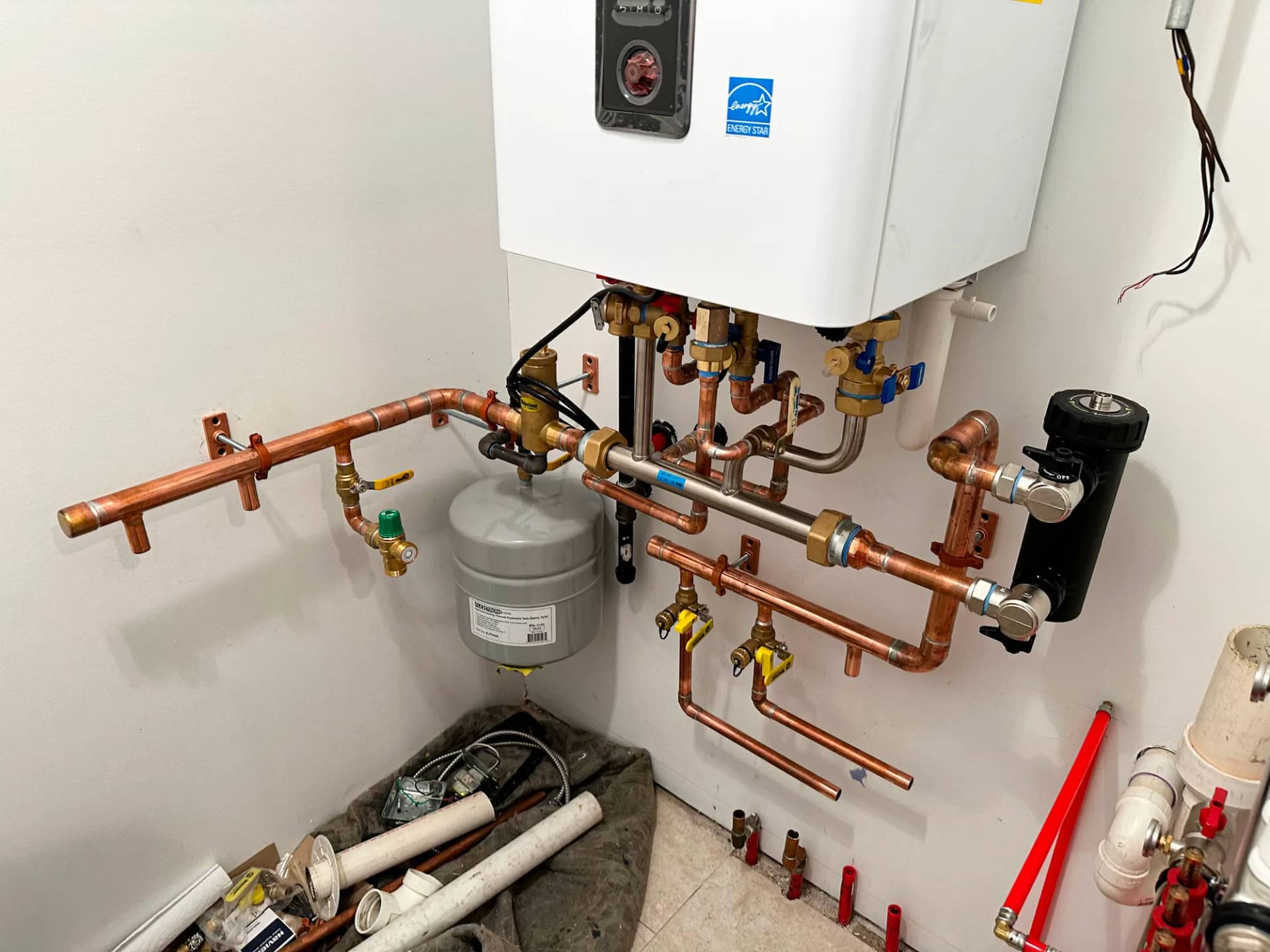
The honest answer is that you do not repair it. There is no economic way to find and fix a leak in copper buried in a slab under a finished house, and replacing the tubing means taking up the floor. What is actually done — and what the trade literature describes as the standard remedy — is to disconnect the buried loop, leave it in the ground, and put the heat back in above the floor with baseboard convectors. Modern installs use PEX rather than copper, but in an occupied Levittown ranch, baseboard is usually the sane answer.
Which is where doing four trades under one roof stops being a slogan. That conversion is three jobs at once. It is a heating job — new distribution, re-piping the boiler, zoning a house that never had zones. It is a plumbing job. And it is a carpentry job, because baseboard has to go round the whole perimeter of a house whose walls, flooring and trim were never designed to have anything run along them. A heating company on its own gets you two thirds of the way and then hands you a phone number. We do the lot with one schedule and one company answering for it.